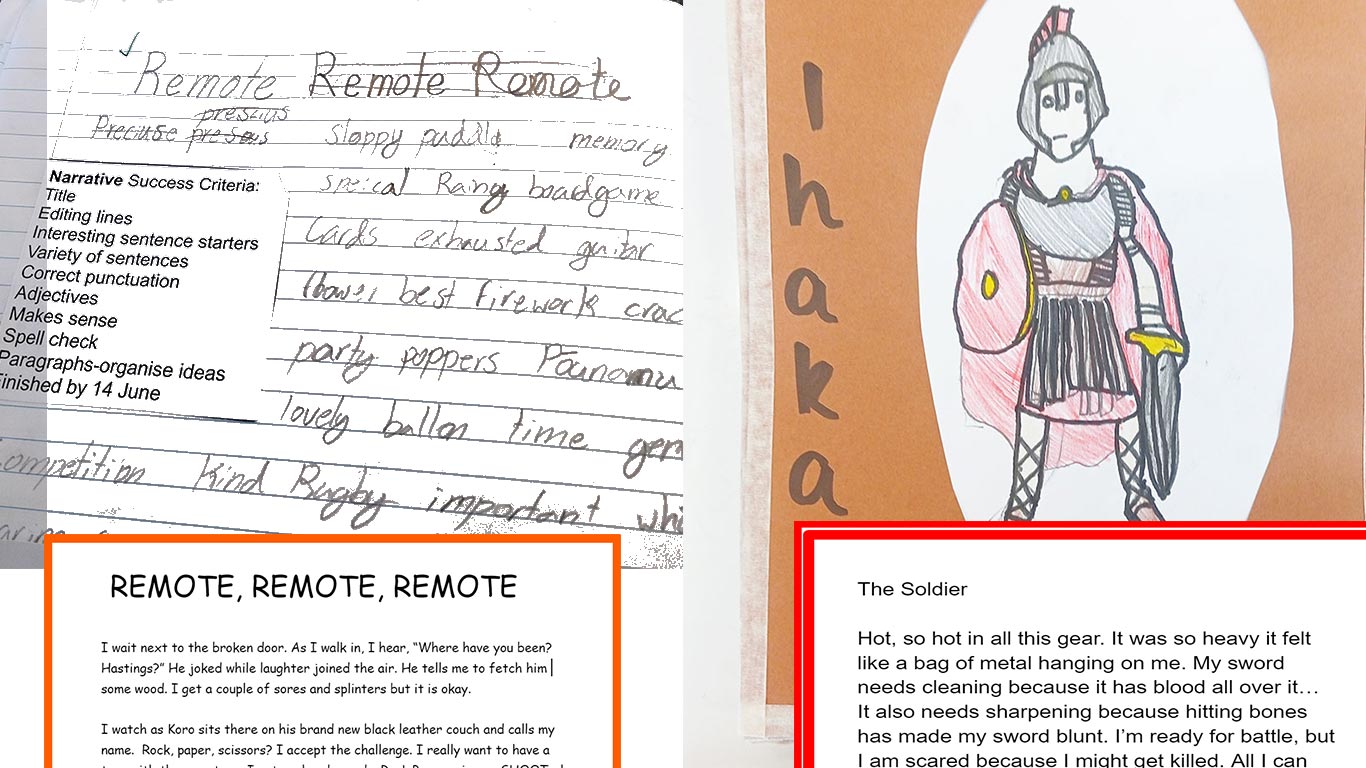
Toward the end of Term Three 2024, I was working with teachers in Hawke’s Bay and two shared great pieces of writing with me that had been written by their tamariki. Although very different pieces – one is as gentle and personal as the other is bloody and gory – both were written by Year 6 boys who often resist writing for various reasons. But they have shown, through these pieces, that there is a story-teller and a writer inside each of these boys. Both are very proud of their texts and are happy to share them with the wider world.
STUDENT ONE: JEVARHN
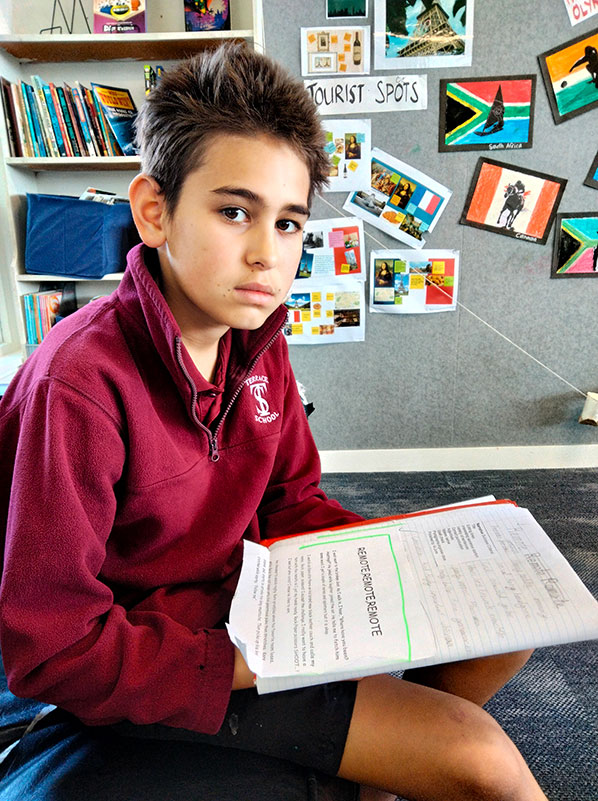
Jevarhn attends The Terrace School in Waipukurau in Central Hawke’s Bay. His beautiful text was inspired by his teacher (Jude Grant) reading Witi Ihimaera’s evocative short story ‘A Game of Cards’ to her students. As ‘A Game of Cards’ (from Witi’s first published volume Pounamu Pounamu) is about the love between a young narrator (probably the author) and his old Nanny, Jude suggested to her students that they think of a person who is very important to them and zoom in on and recall a special memory of that person.
Jude read the story as part of the school’s Matariki study and its notion of belonging. As she explained, I read the story to get the students to think about the connections we have with whanau and how these shape us both as individuals and within the whanau group. I encouraged them to remember people who they have been close to or are close to now; people who are significant in their lives. She added, As a school with 80% Māori students, we have a strong Te Ao Māori lens which we integrate into all curriculum areas.
Jevarhn immediately thought of his Koro who he is very close to, especially since his Nan passed. Jevarhn attempts to portray the relationship between his (very much alive) Koro and himself by recounting an anecdote featuring a television remote, just as Witi attempted to portray his relationship with his dying Nanny through the context of a game of cards. Both are very successful. Maybe Jevarhn will become the next Witi Ihimaera?
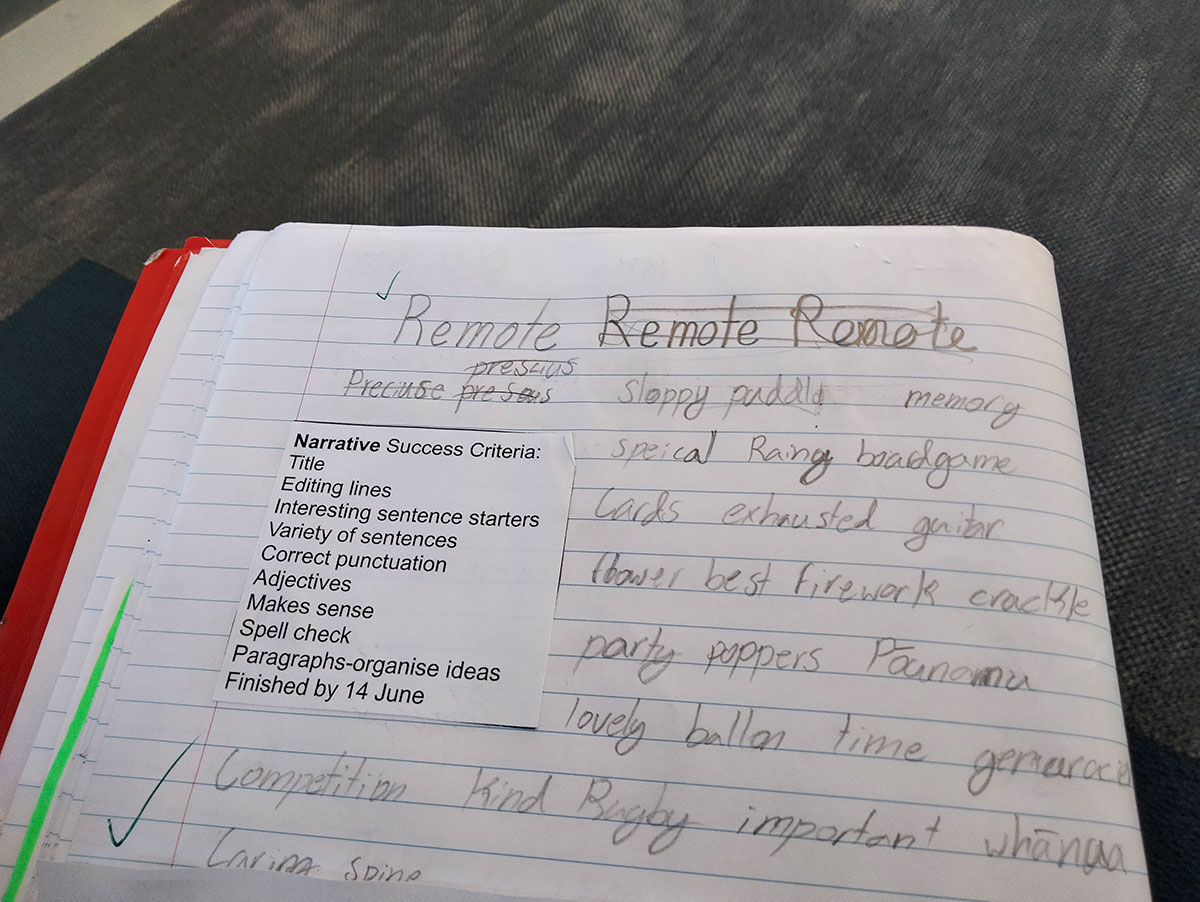
Jevarhn brainstormed possible anecdotes he could tell and settled on an incident with a television remote because he thought it best exemplified his grandfather and would best illustrate what he meant to him. His planning notes also contain the criteria that Jude had set with her students for the task.
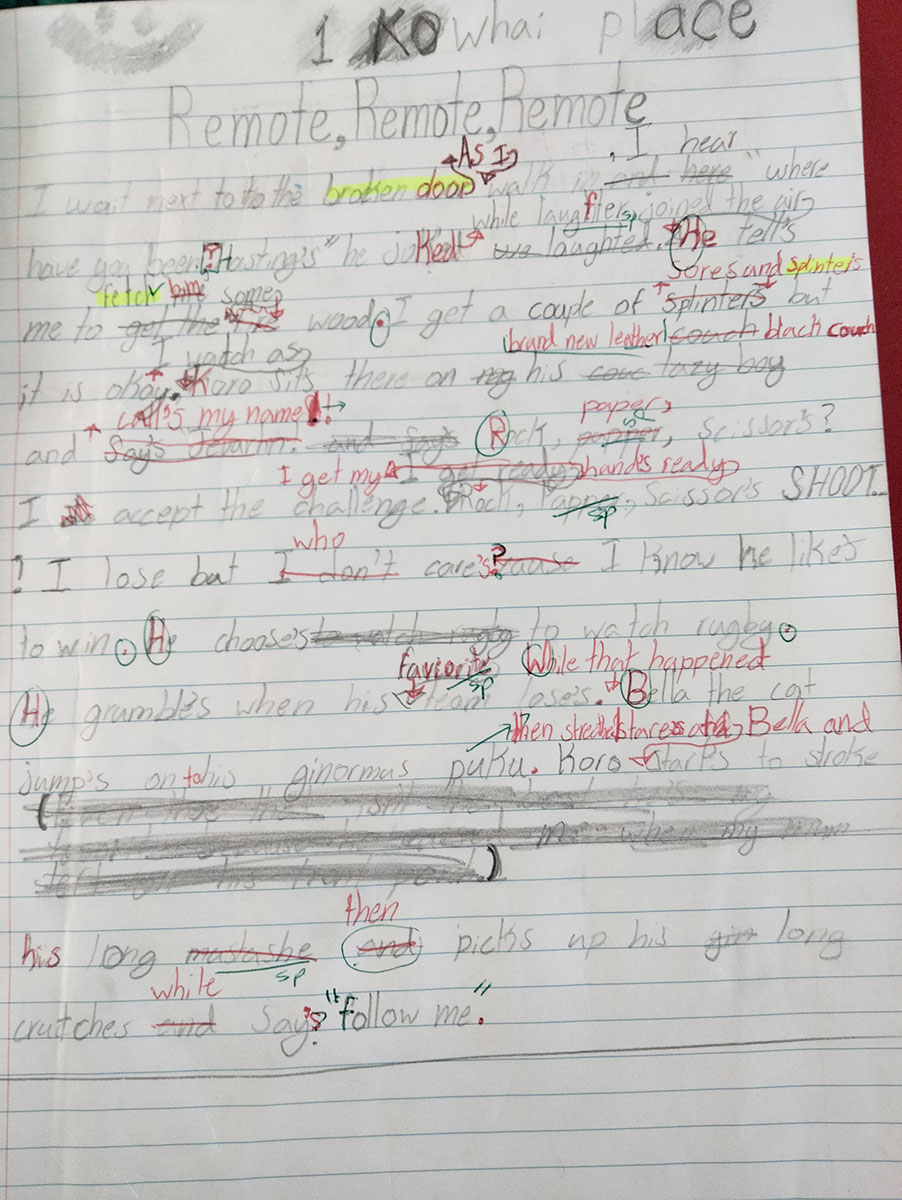
He then crafted an initial draft from the planning and re-crafted it with meticulous care following a conversation with his teacher. Note that Jude has guided him around spelling and punctuation corrections to be made, but Jevarhn himself has decided on the deeper feature changes. For example, he alters the beginning of the second sentence so that it becomes a complex sentence, he adds detail about a key item (the couch upon which his Koro sits) and he deletes extraneous detail near the end.
Here is Jevarhn’s published text along with a video of him proudly reading his text aloud.
Read the text – click to open in new tab ⧉
Watch The Video
Incidentally, I am not the only one to appreciate the simple beauty of Jevarhn’s text. It has been accepted for publication in Toitoi, and Charlotte (the editor) tells me that it will be published in the final edition for 2024, alongside a piece of art inspired by the story. Look out for it. And congratulations Jevarhn.
STUDENT TWO: IHAKA
Ihaka attends Bledisloe School in Napier. His vivid and somewhat violent and gory text was inspired by a discussion that he was having with his teacher, Travis Sumner. The class was undertaking an inquiry study of Ancient Civilizations and were wondering what it would be like to live in another time period. Travis had encouraged his students to choose a person that they had read about during the study – maybe a soldier or a slave, a priest, king or a queen or even a potter or a blacksmith – and to write about what life must have been like for them: What was their day like? What might they get up to? What would they look like and sound like? How might they feel? The writing was obviously to be imaginative but would be based on facts that they had learnt.
Ihaka chose to envisage himself as a Roman soldier who was in a very bloody battle with another Roman soldier. He loved the idea of making this gory situation come alive over the two prescribed writing sessions.
Ihaka needed minimal scaffolding from Travis to get into this task. As Travis explained, Most of the scaffolding was through oral communication and regular check-ins with him. He was deeply engaged in his writing and to pull him down to partake in a modelling session would have just removed him from his engagement in the task.
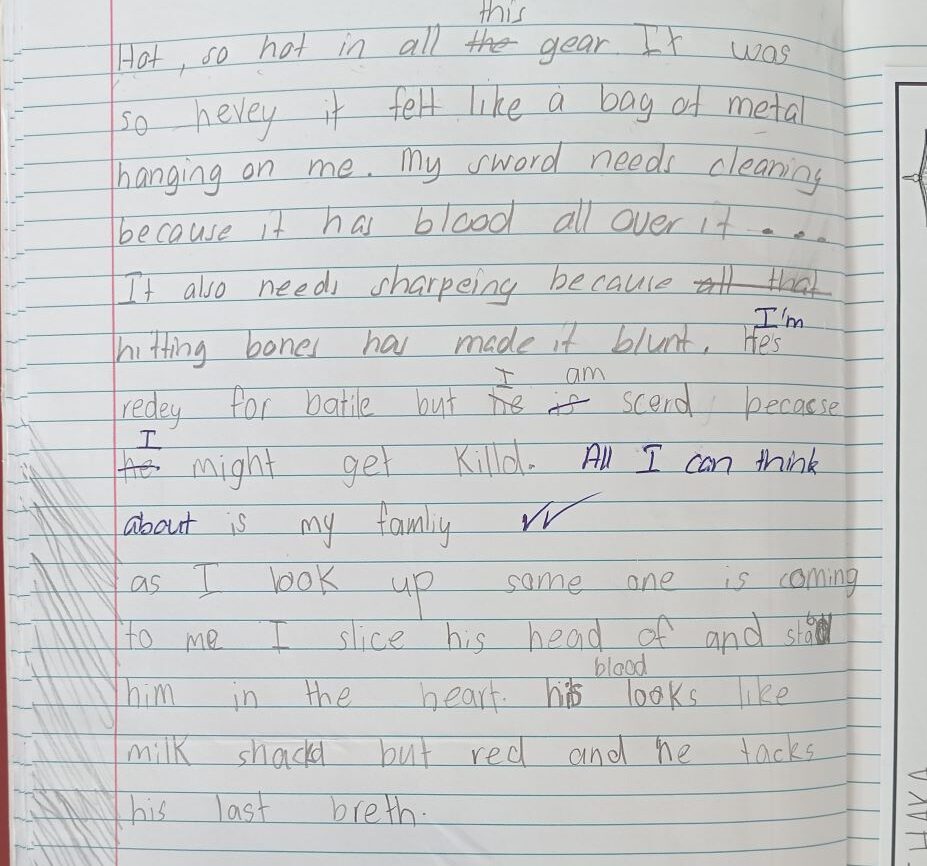
Note below how he has re-crafted his text. In particular, note how (in conjunction with the teacher) he has made changes to achieve consistency of person and tense. He was determined to make the text work for a reader.
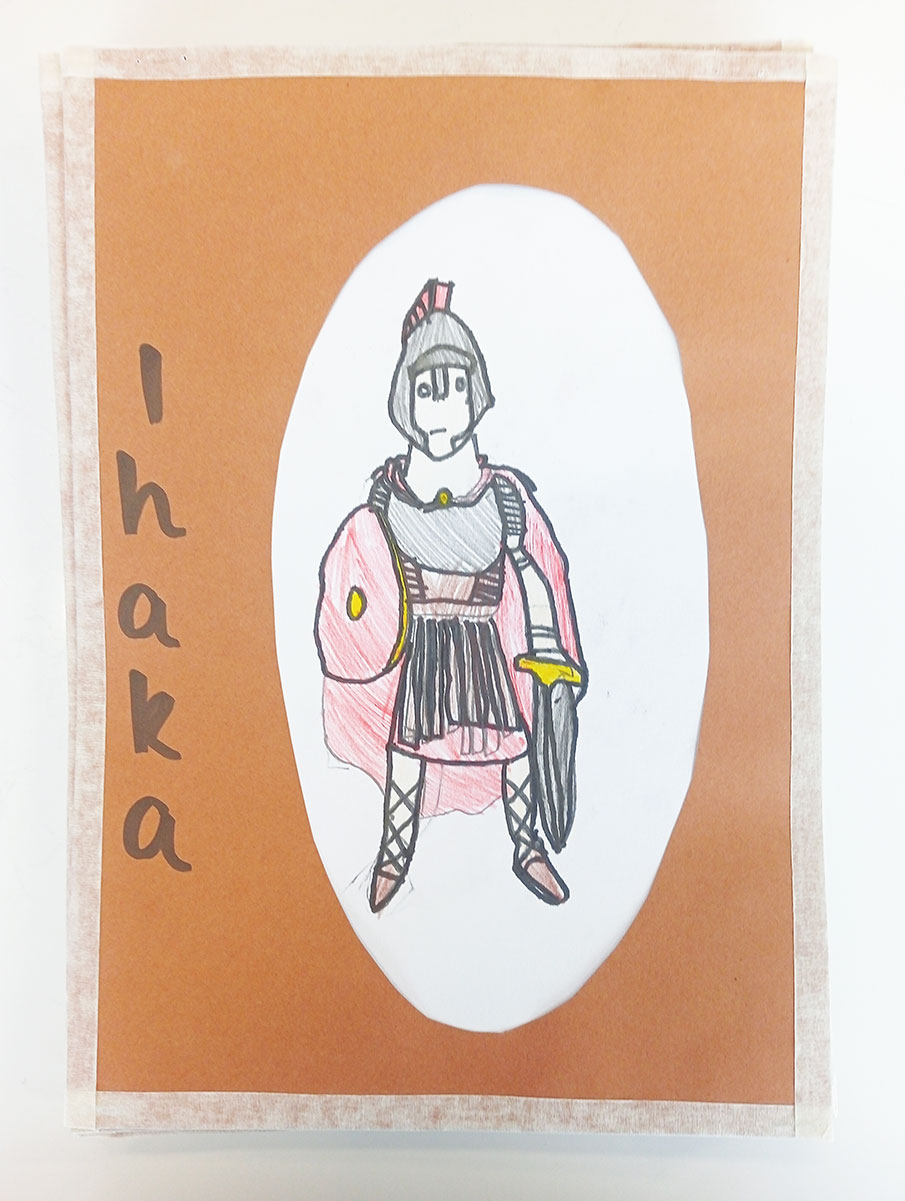
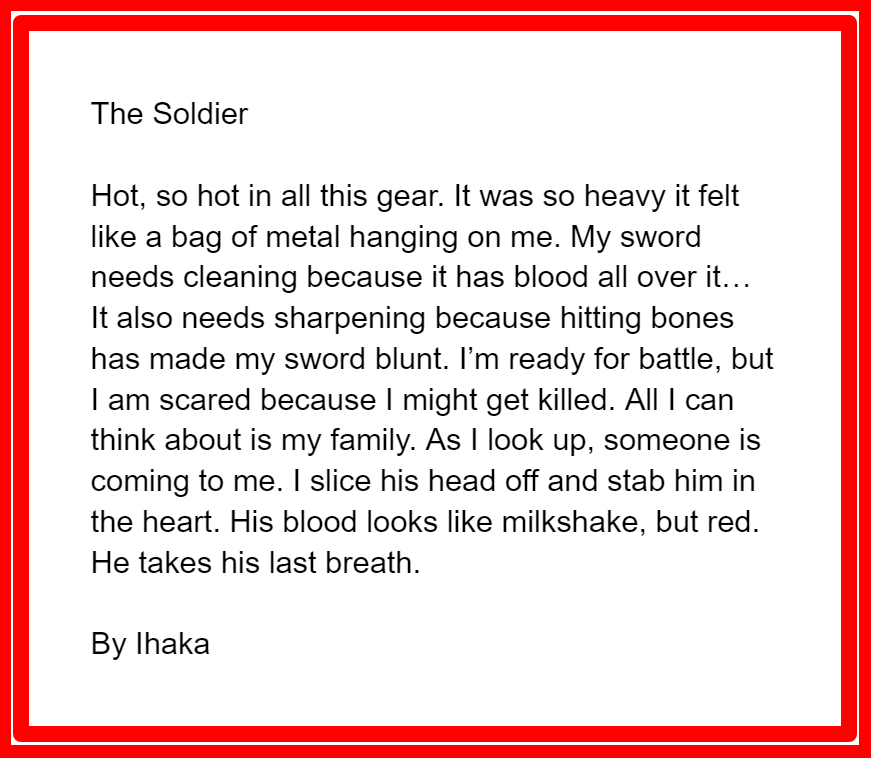
Here is Ihaka’s published text, along with an illustration that he completed to go with it.
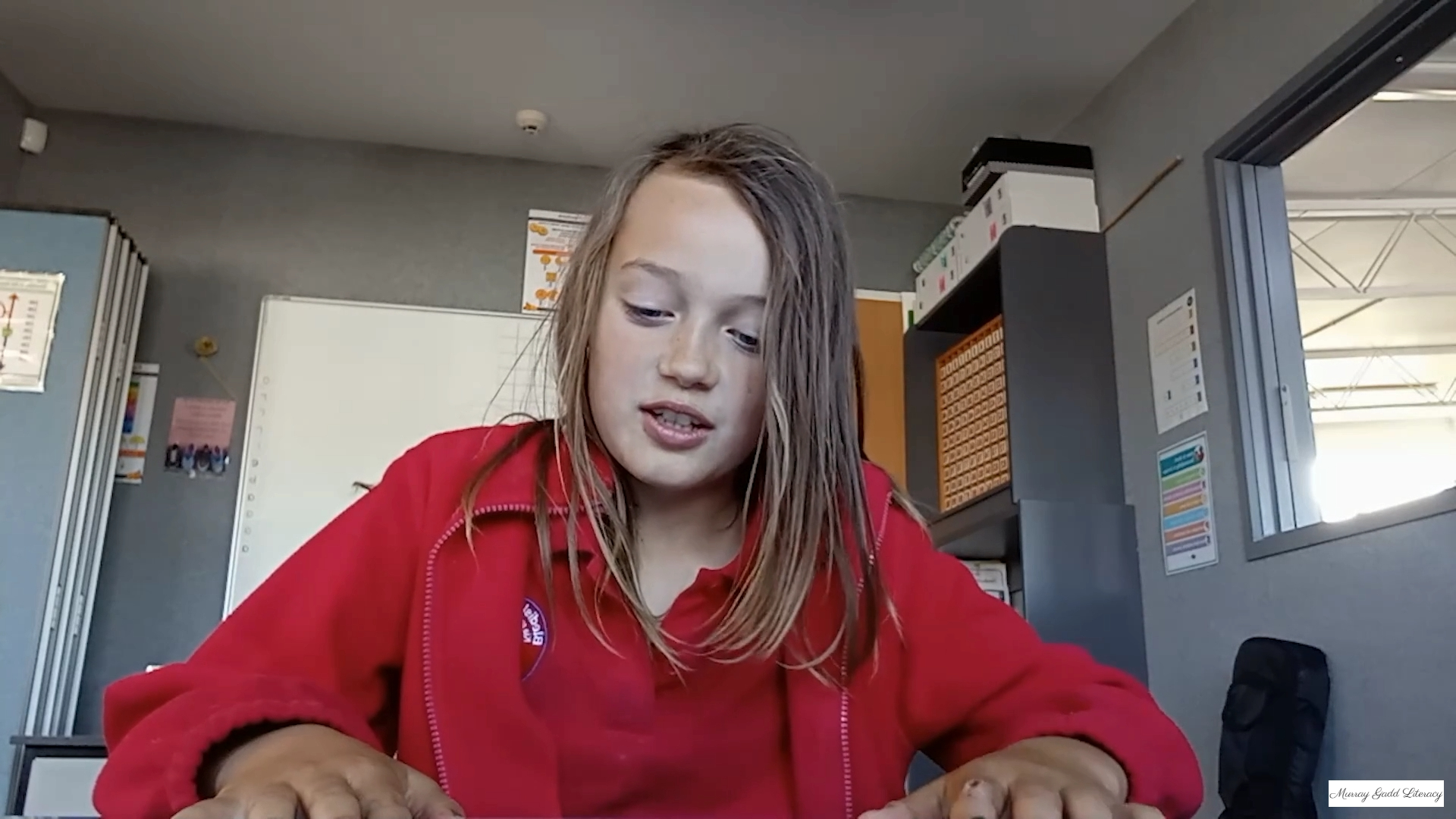
And here is Ihaka proudly reading his text aloud to camera. Incidentally, it’s not hard to pick up, from the video, the great relationship that he holds with his teacher who supports him during filming.
Click here to view the final version ⧉
Watch The Video
Some teachers may question the ethics of allowing a student to publish such a violent and gory text – especially the head being chopped off and the blood ‘looking like milkshake’ – but Travis had no qualms. As he explained to me, Ihaka struggles to engage with his learning in the classroom environment, especially when he cannot see himself being successful or finding success early in a set task….So it was important that once he engaged in this task and wanted to write about a soldier fighting, I let him. I knew that the guts and the gore was going to come, but at least it meant that he was writing.
As Travis explained further to me, What was vitally important was that I didn’t correct all the errors in Ihaka’s draft, and make him feel like he had not had success. Picking my battles and focussing on touching up a couple of little things at a time was definitely the way to go.
I would agree with Travis – our aim is to get a lad like Ihaka writing and excited about his writing. We can help him fix up selected mistakes – and undertake some direct and explicit instruction with him about word and sentence formation – during a final conference for publishing just as Travis did, rather than throughout the writing process.
SOME CONCLUDING POINTS
Both of these Year 6 boys (who are sometimes reluctant to write) felt excited about their writing and have achieved great success with it.
But an additional point needs to be made. Both lads are lucky enough to be placed with teachers who really care for them as unique culturally-centred learners and have developed great relationships with them. As Ihaka’s teacher told me, It would have been impossible to get [the student] invested if the foundational relationship was not there. We have long known about the importance of teachers holding warm, positive and mutually-respectful relationships with their students if students are to engage and achieve in their learning.
Both of these teachers illustrate the importance of holding great teacher-student relationships beautifully.
What do you think? Let us know your thoughts in the comments below.
Murray Gosling
Being a Learning Support Coordinator based at Terrace School and regularly interacting with students from Jude’s class, it is clearly evident that she knows her students very well. She provides them with not only a wealth of rich language on a daily basis but makes the content relevant to them so that she gets a high level of engagement. I was blown away by Jevarhn’s piece of writing as he must have been fully engaged and interested as it was evident that he was proud of his mahi. Jude is what I call ‘an old fashioned teacher’ ( take it as a complement Jude!). Her writing programme is consistent and regular. All of her students know what they are writing and why. The books she reads are well chosen and popular and most students love just sitting and listening. I did that for 10 minutes this afternoon as well. Thanks Murray for highlighting and sharing both Jude’s and Jevarhn’s writing adventure.